Content Is King - How And Why You Need To Do It
Without Content, You Will Not Get Found In The Key Areas Of Search....PERIOD!

The internet has changed EVERYTHING and that change has accelerated in the past 3 years with better technology, tablets, smart-phones and more. This coupled with the changing demographics of "today's consumer", demands that you develop, maintain and push out content: where your customer wants it, when they want it and how they want it. The Internet has changed everything. How we get information, news, entertainment. How we connect with friends, family, products, pricing, services and more.
Content (Content Is KING!!!)
Here is where a sale is generally won; give the customer a great shopping environment with lots of products and an easy to shop format. If you don't show a lot of product with "relevant descriptions and specifications", the consumer will assume you don't carry what they are looking for and most likely move on to a retailer that shows what they're looking for.
Many products are complex and information rich. You make money by selling the products that you offer. The main reason a consumer visits your retail website is because they are considering purchasing your products. The more you show, the more inquiries you'll get and ultimately you'll sell more.
Below we will reference some great articles, white paper links, Infographics and more to make our case. Please note that just a few years ago - 2005 - PriceWaterhouseCoopers did a retail report whose cover page said this:
Content (Content Is KING!!!)
Here is where a sale is generally won; give the customer a great shopping environment with lots of products and an easy to shop format. If you don't show a lot of product with "relevant descriptions and specifications", the consumer will assume you don't carry what they are looking for and most likely move on to a retailer that shows what they're looking for.
Many products are complex and information rich. You make money by selling the products that you offer. The main reason a consumer visits your retail website is because they are considering purchasing your products. The more you show, the more inquiries you'll get and ultimately you'll sell more.
Below we will reference some great articles, white paper links, Infographics and more to make our case. Please note that just a few years ago - 2005 - PriceWaterhouseCoopers did a retail report whose cover page said this:
"If a retailer does not recognize the changing dynamics of the consumer, how they will shop and connect with brands in the future, they will not just be punished; they will be punished with impunity".

Related Content

Click Here To Visit Our Site Index For More Information On This Subject
How to Build and Operate a Content Marketing Machine
June 13, 2012 - By Toby Murdock

|
Content marketing is hot. White hot. SEO and digital-marketing thought leaders are declaringcontent marketing the next big thing.
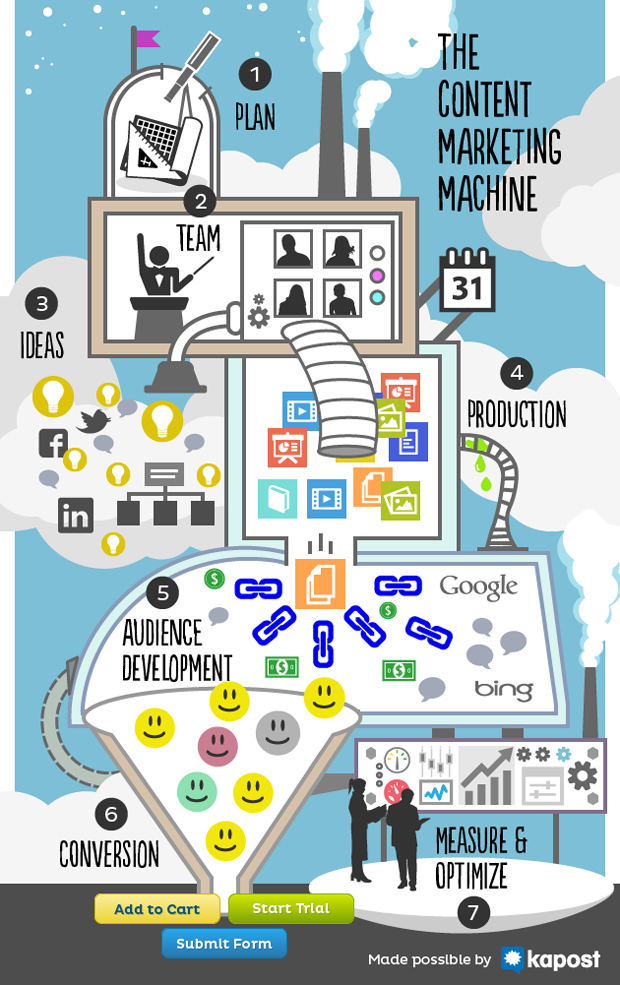
The strategy of content marketing makes sense: Instead of pushing messages about your product at prospects, pull prospects toward you by publishing content about your prospects’ interests. Search rank, traffic, leads, and all sorts of goodness flow from this approach. So the conversation is no longer about “if” or “why” an organization should practice content marketing. Rather, the still-unanswered question is “how”? How does a brand actually become a publisher, produce great content, and attract traffic and generate conversions? So if you’re wondering the same thing, fear not. This post is your guide to building and operating a Content Marketing Machine. But, to be clear, I’m not talking about dipping a toe in the water—publishing some blog posts, busting out an infographic. I’m talking about a sustained effort to generate content excellence in your category. I’m talking about a machine that generates more traffic and leads at a lower cost than all of your other channels combined. The MachineFirst, let’s take a look at the machine, with all of its pistons, cogs, smokestacks, and miscellaneous parts. This gives you an overview of what you’re building and what you’re going to operate: |
|
Goals & Plan

What is the goal, the end output for your Content Marketing Machine? Content marketing is utilized for lots of objectives, including customer retention, upsell, support, and brand awareness. But by far the major objectives for most content marketers are lead generation and customer acquisition, which can take the form of adding an item to a shopping cart, filling out a lead-gen form, or signing up for a trial.
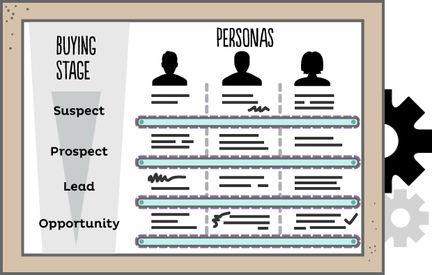
Your plan then becomes to create a content-powered path that takes your prospects from where they are today to the end goal. This path is best plotted on a matrix, called The Content Grid, where one axis lists your customer personas and the other axis lists your various stages in the buying cycle. Let’s get a close-up on this part of the machine here:
Your plan then becomes to create a content-powered path that takes your prospects from where they are today to the end goal. This path is best plotted on a matrix, called The Content Grid, where one axis lists your customer personas and the other axis lists your various stages in the buying cycle. Let’s get a close-up on this part of the machine here:
|
Next, for each cell in this grid, you must ascertain which types of content will attract personas to each stage and help move them along to the next stage. Specifically, each cell should answer the following questions:
|
|
Team

|
So you’ve got a plan. Now you have to figure out who is going to execute it. Begin by looking at your grid. Who can produce these pieces of content? Internal contributors? External, paid freelancers? Guest posters?
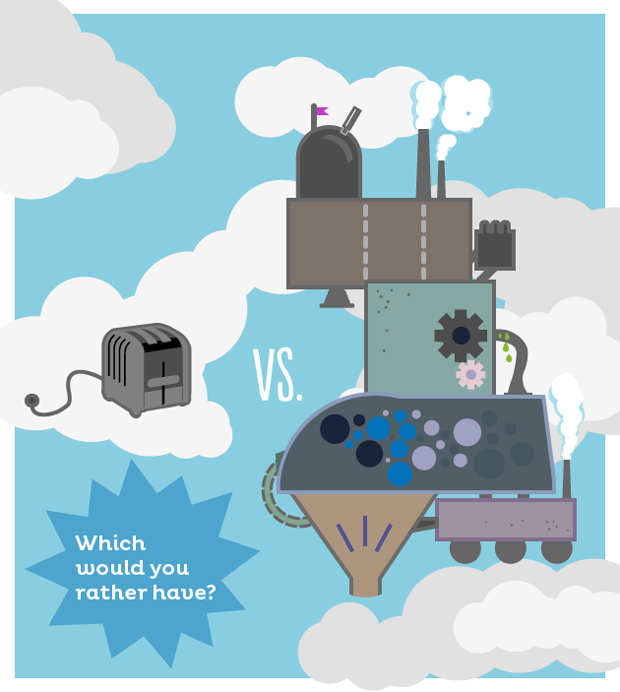
Naturally, this depends a good amount on your budget. But for most organizations it is a mix of internal and external contributors: You’ll want to utilize your unique internal expertise, but external talents should share the burden, particularly when it comes to rich media content like video and infographics. While contributor staffing varies, there is one consistent, crucial role: the managing editor. Many stakeholders will submit ideas and content into the Content Marketing Machine, turn its audience development crank, and pull leads and reports out of the machine. But you need at least one person whose primary responsibility is to man the controls of the machine: to plan the editorial calendar, to supervise content production and distribution, to generate traffic and conversions, to monitor metrics, and to be accountable for results. Without such a person, you aren’t operating a machine, but rather a small appliance (perhaps a Content Marketing Toaster). |
Ideally, the managing editor should have content experience from a journalism, copy writing, or PR background. But the managing editor should also know the web and the ways of search, social, analytics, and link-building. Lastly, the managing editor should be familiar with marketing and the objectives of driving traffic and conversions.
|
Ideas
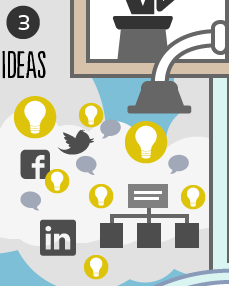
The Ideas section of the Content Marketing Machine is where marketers most often struggle. In the Content Marketing Institute’s 2012 Content Marketing Research Report, over half of those surveyed said that creating consistent content was their greatest challenge, with a particular struggle in figuring out what to produce. To truly become a publisher requires consistently producing content—three, four, five times a week. “What in the world,” marketers lament, “am I going to write about every day?”
Remember: The bulk of the content you are going to produce is about your customers’ interests, not about your products. Thus, the best way to generate ideas is to understand what your customers are interested in.
There are two best practices for idea generation. First is online social listening. Dive into the categories you are covering on Twitter, Facebook, LinkedIn, etc. See which topics the communities are interested in. Question-and-answer sites like Quora and Yahoo Answers can identify the specific questions your prospects want answered.
The other best practice is leveraging the ears within your organization. Your colleagues in sales, services, support, etc. are talking with customers every day. Encourage them to listen for nuggets of customer concern, and then submit those to the content marketing team. To give your colleagues incentive to participate, make sure their submissions don’t end up in a black box. Instead, if you reject them, let them know. If you accept them and convert the idea into content, keep them informed of the content and how it performs. The best organizations keep a leaderboard to showcase which employees are making the best idea contributions to the company’s content marketing efforts.
Remember: The bulk of the content you are going to produce is about your customers’ interests, not about your products. Thus, the best way to generate ideas is to understand what your customers are interested in.
There are two best practices for idea generation. First is online social listening. Dive into the categories you are covering on Twitter, Facebook, LinkedIn, etc. See which topics the communities are interested in. Question-and-answer sites like Quora and Yahoo Answers can identify the specific questions your prospects want answered.
The other best practice is leveraging the ears within your organization. Your colleagues in sales, services, support, etc. are talking with customers every day. Encourage them to listen for nuggets of customer concern, and then submit those to the content marketing team. To give your colleagues incentive to participate, make sure their submissions don’t end up in a black box. Instead, if you reject them, let them know. If you accept them and convert the idea into content, keep them informed of the content and how it performs. The best organizations keep a leaderboard to showcase which employees are making the best idea contributions to the company’s content marketing efforts.
Production
|
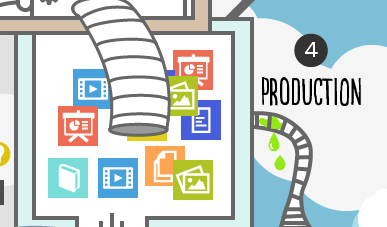
Once idea generation picks up, the next step is to operate the heart of the Content Marketing Machine: content production. The centerpiece of production is an editorial calendar, which should specify who is going to create what content, when they will submit it, when you plan to publish it, and where you plan to publish it (your site, YouTube, Slideshare, all of the above, etc.).
|
|

Your editorial calendar should also include the customer personas and buying stages for which the content is intended. As you look over your calendar, you should be able to visually see whether or not you are producing the right content mix to cover the various cells in your Content Grid.
Many organizations can get buried in the logistics of the production stage. Various stakeholders might be involved, including the idea generator, the content creator, graphic designers, the managing editor, the SEO expert, the social media team, legal and PR (for approvals), etc. Often, too much of the effort goes into coordinating these players instead of creating great content.
If your organization is moderately sized and decently complex, make sure you map out the process involved in order to get content out the door. Who will submit the content? Who needs to approve it and at what stage of the process? Who is going to be posting updates to Twitter, Facebook, and LinkedIn once the content has been published? Identify the required workflows and have a plan to manage them so that your efforts don’t get consumed by administrative tasks.
Many organizations can get buried in the logistics of the production stage. Various stakeholders might be involved, including the idea generator, the content creator, graphic designers, the managing editor, the SEO expert, the social media team, legal and PR (for approvals), etc. Often, too much of the effort goes into coordinating these players instead of creating great content.
If your organization is moderately sized and decently complex, make sure you map out the process involved in order to get content out the door. Who will submit the content? Who needs to approve it and at what stage of the process? Who is going to be posting updates to Twitter, Facebook, and LinkedIn once the content has been published? Identify the required workflows and have a plan to manage them so that your efforts don’t get consumed by administrative tasks.
Audience Development
So, you’re publishing content now. Your machine is up and running. Congratulations!
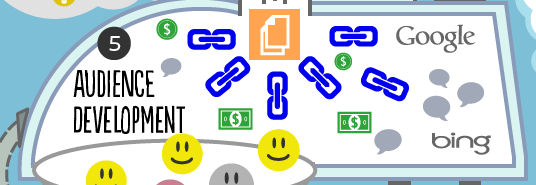
However, creating the content is merely half of your task. The other half is focused on attracting visitors to that content, which is the audience development component of the Content Marketing Machine. Audience development breaks down into four major buckets:
Your objective is to win links to your content from these influencers. Get started by building relationships with them. Retweet their tweets. Comment on their blogs. Engage in a dialogue.
Once you’re on an influencer’s radar, craft content with the objective—a link from that influencer—in mind. Ask yourself: What content would be of enough interest to this influencer that they would share it with their audience? Or try to bring influencers into the process from the start: Tell them about the content you are working on and solicit their feedback or a quote.
Search. Winning influencer links is the key to referral traffic for your content. It is also the best way to improve in this second category of audience development: search traffic. Win links from authoritative influencers, and the search engines will improve your rank, driving more traffic. Of course, you must be deliberate about this process: Identify the keywords your personas will search for; target and optimize your content for each keyword; and track how your content efforts, keyword by keyword, are affecting your search ranking.
Paid. Despite all the inbound, organic goodness at the core of content marketing, paid traffic does have a place in the mix. Whether it’s SEM, Facebook ads, sponsored tweets, or paid email-newsletter distribution, using paid tactics is part of the Content Marketing Machine. But notice how content marketers are paying to drive traffic to their content pages (pages containing content created with the prospects’ interests in mind) instead of their product pages. The process of developing a relationship with a prospect built on informative content is so powerful that marketers are taking the more patient but more effective approach of buying traffic to their content.
Syndication. Finally, the content you produce need not be limited to your own properties (your site, YouTube account, Slideshare account, etc.). The most straightforward way to earn a link from a site frequented by your prospects is to offer that site quality content. Syndicating your content earns at least one link to your site through your author bio, and it also begins to develop a relationship between you and your prospects before they ever visit your site. Particularly at the beginning of your efforts, other sites will often have more traffic than yours, so syndicating content is a great way to get your traffic off the ground.
However, creating the content is merely half of your task. The other half is focused on attracting visitors to that content, which is the audience development component of the Content Marketing Machine. Audience development breaks down into four major buckets:
- Influencers
- Search
- Paid
- Syndication
Your objective is to win links to your content from these influencers. Get started by building relationships with them. Retweet their tweets. Comment on their blogs. Engage in a dialogue.
Once you’re on an influencer’s radar, craft content with the objective—a link from that influencer—in mind. Ask yourself: What content would be of enough interest to this influencer that they would share it with their audience? Or try to bring influencers into the process from the start: Tell them about the content you are working on and solicit their feedback or a quote.
Search. Winning influencer links is the key to referral traffic for your content. It is also the best way to improve in this second category of audience development: search traffic. Win links from authoritative influencers, and the search engines will improve your rank, driving more traffic. Of course, you must be deliberate about this process: Identify the keywords your personas will search for; target and optimize your content for each keyword; and track how your content efforts, keyword by keyword, are affecting your search ranking.
Paid. Despite all the inbound, organic goodness at the core of content marketing, paid traffic does have a place in the mix. Whether it’s SEM, Facebook ads, sponsored tweets, or paid email-newsletter distribution, using paid tactics is part of the Content Marketing Machine. But notice how content marketers are paying to drive traffic to their content pages (pages containing content created with the prospects’ interests in mind) instead of their product pages. The process of developing a relationship with a prospect built on informative content is so powerful that marketers are taking the more patient but more effective approach of buying traffic to their content.
Syndication. Finally, the content you produce need not be limited to your own properties (your site, YouTube account, Slideshare account, etc.). The most straightforward way to earn a link from a site frequented by your prospects is to offer that site quality content. Syndicating your content earns at least one link to your site through your author bio, and it also begins to develop a relationship between you and your prospects before they ever visit your site. Particularly at the beginning of your efforts, other sites will often have more traffic than yours, so syndicating content is a great way to get your traffic off the ground.
Measurement & Conversion
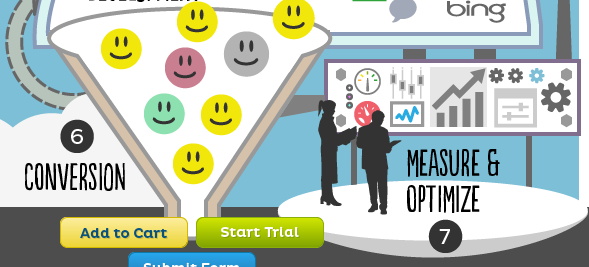
OK, now the machine is running full tilt. You’re producing content, and visitors are coming to you specifically for that content. As the machine runs, you’ll need to keep an eye on a specific set of gauges for each part of the machine so that you can learn about how it’s running and continue to tune it and optimize performance.
Ideas and Production. Keep an eye on the mix of content you are pushing out the door. Do you have the right distribution across the personas from your Content Grid? Are you hitting the relevant categories?
Audience Development. Which influencers are sending you the most traffic? Be sure to express your gratitude to them and link back. Which types of content are succeeding in generating the most valuable links? Double down on that content. Which keywords have high search volumes but fail to drive you much traffic? Improve your production of content around these keywords to improve your rank. Which paid channels are proving the most cost-effective?
Traffic and Conversion. This is the biggie, since your goal is conversion. All of your content needs to be assessed for its ability to attract first-time and returning visitors, as well as how it’s moving them through the buying cycle, particularly to the conversion event you’re tracking (i.e. a form submission, Add to Cart, Start a Trial, etc.). Score all your content and look for the trends: Which authors are pulling in the most new visitors? Which content types (i.e. blog posts, e-books, videos) are keeping each of my personas coming back? Which categories of content are leading to the most conversion events?
Every initial content strategy is a best guess. Only by operating your machine and monitoring your metrics can you understand what’s working and what’s not working, and improve your performance over time.
Ideas and Production. Keep an eye on the mix of content you are pushing out the door. Do you have the right distribution across the personas from your Content Grid? Are you hitting the relevant categories?
Audience Development. Which influencers are sending you the most traffic? Be sure to express your gratitude to them and link back. Which types of content are succeeding in generating the most valuable links? Double down on that content. Which keywords have high search volumes but fail to drive you much traffic? Improve your production of content around these keywords to improve your rank. Which paid channels are proving the most cost-effective?
Traffic and Conversion. This is the biggie, since your goal is conversion. All of your content needs to be assessed for its ability to attract first-time and returning visitors, as well as how it’s moving them through the buying cycle, particularly to the conversion event you’re tracking (i.e. a form submission, Add to Cart, Start a Trial, etc.). Score all your content and look for the trends: Which authors are pulling in the most new visitors? Which content types (i.e. blog posts, e-books, videos) are keeping each of my personas coming back? Which categories of content are leading to the most conversion events?
Every initial content strategy is a best guess. Only by operating your machine and monitoring your metrics can you understand what’s working and what’s not working, and improve your performance over time.
Building Your Own Machine (Versus Renting Someone Else’s)
Building Your Own Machine (Versus Renting Someone Else’s)Indeed, it’s imperative to recognize that the results of content marketing accrue over time. Traditional marketing tactics, such as advertising, are the equivalent of renting the attention of someone else’s audience: paying another media outlet to put your messages in front of that outlet’s audience. Despite advertising’s problems, it has immediate effects, because the media already has an audience.
Content marketing takes longer because an audience needs to be developed. But don’t be deterred! Just like the differences between buying and renting a house, you are building equity with content marketing as you build your audience. Over time, that audience becomes an incredible asset—a perpetual source of leads, trials, and new customers at an extremely low cost relative to traditional marketing tactics such as advertising. (For more information on content marketing economics and ROI, read this e-book). Today, many brands have successfully built and now operate their own Content Marketing Machines.
Here are 50 examples from brands we’re watching in 2012.
Content marketing takes longer because an audience needs to be developed. But don’t be deterred! Just like the differences between buying and renting a house, you are building equity with content marketing as you build your audience. Over time, that audience becomes an incredible asset—a perpetual source of leads, trials, and new customers at an extremely low cost relative to traditional marketing tactics such as advertising. (For more information on content marketing economics and ROI, read this e-book). Today, many brands have successfully built and now operate their own Content Marketing Machines.
Here are 50 examples from brands we’re watching in 2012.